
How To Stop Confidential Data Leakage From Internal GenAI Apps: A 2025 Enterprise Playbook

Stop confidential GenAI leakage by tightening day-one controls (SSO, provisioning, retention), enforcing real-time prompt and output redaction at the boundary with GenAI Protector Plus, locking down RAG sources and integrations, routing confidential collaboration into CoSpaceGPT, and using WebOrion® Monitor to catch unauthorised public-site changes quickly, all within a practical 90-day rollout.
Best Practices For Securing Employee Use Of ChatGPT In A Corporate Environment: The 2025 Enterprise Guide To Safe Enablement

ChatGPT said:
This article explains how to secure employee use of ChatGPT in a corporate environment by making safe behaviour the default through identity, retention, guardrails, and audit-ready governance. It lays out a practical baseline checklist (SSO and MFA, SCIM lifecycle controls, retention and export rules, connector restrictions, SIEM logging, change control, and lightweight training), then shows how to route sensitive or collaborative work into CoSpaceGPT so model choice, sharing, retention, and audit trails stay governed in one place. It also clarifies where GenAI Protector Plus fits to protect the LLM traffic and GenAI apps you control, and how WebOrion® Monitor helps protect brand trust by detecting public-site defacement or unintended changes, supported by a structured 90-day rollout and a quarterly review rhythm.
Best Generative AI Security Solutions For Enterprises: The 2025 Buyer’s Guide To Layered Protection
This article explains why enterprises should secure GenAI before scaling, covering LLM-specific risks like prompt injection, insecure output handling, data poisoning, model denial of service, and supply chain exposure, alongside classic web and app threats. It shows how layered protection works in practice with a GenAI firewall for prompts and responses, a secure workspace for governed employee use, and website integrity monitoring to protect public-facing sites. You will also get a clear evaluation framework, a rollout sequence aligned to NIST AI RMF-style governance, a worked ROI and TCO example, and a clearly labelled hypothetical case study showing how the layers reduce shadow use and create audit-ready evidence.
How to Secure RAG Applications with GenAI Firewall
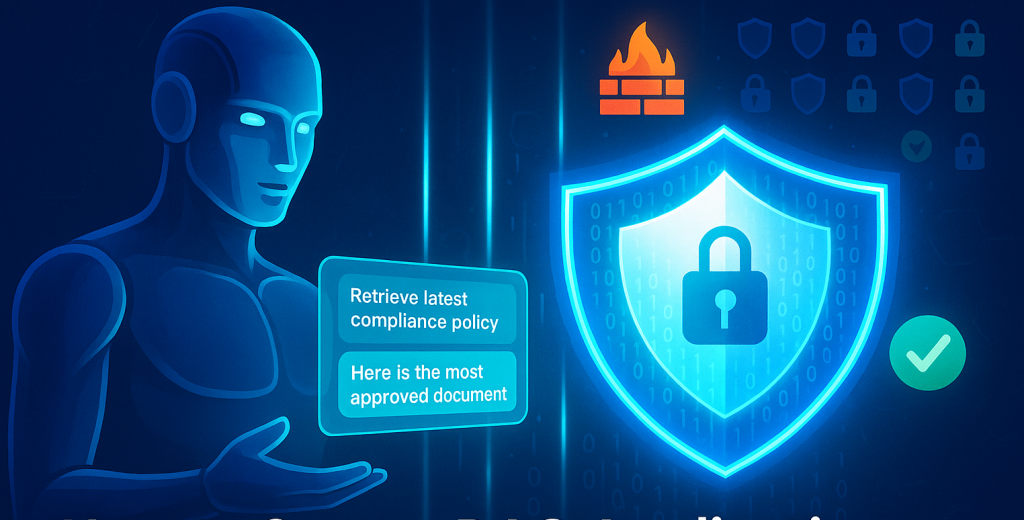
Learn how to secure RAG apps with a GenAI firewall, from blocking prompt injection to hardening retrieval, governance, and monitoring for compliant AI at scale.
How to Prevent Prompt Injection Attacks in Enterprise GenAI Applications
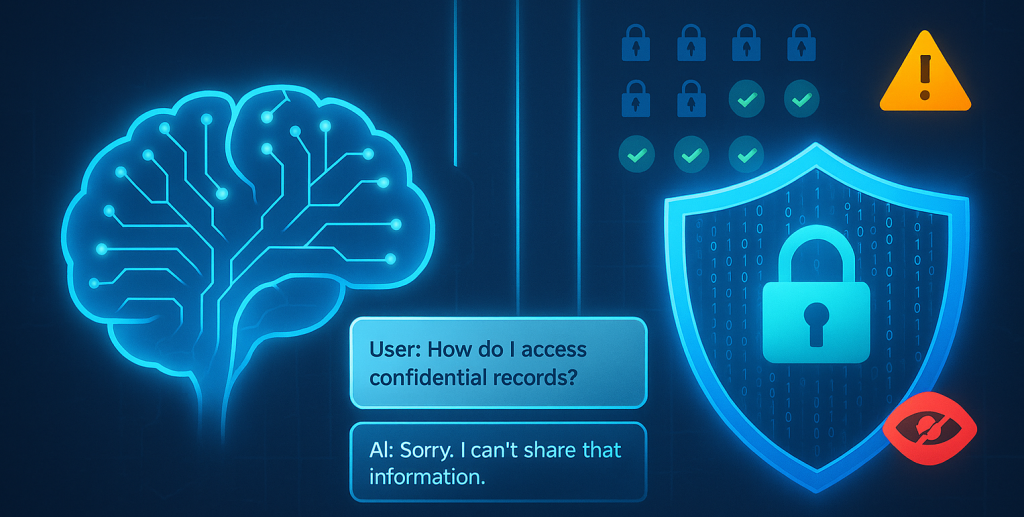
Prompt injection attacks can trick GenAI into leaking data or ignoring rules, making them a critical enterprise risk. Learn what they are, why they matter now, and the defences that keep AI secure without losing its usefulness.
How to Defend Your AI Supply Chain: Preventing Data Poisoning and Model Integrity Attacks in LLM Deployments
The rapid adoption of generative AI in enterprises has opened new avenues for innovation – and new avenues for attack. While companies rush to integrate large language models (LLMs) into products and workflows, security teams are sounding alarms about the LLM supply chain. In plain terms, an AI’s “supply chain” includes all the inputs and […]
Safely Fine-Tuning LLMs with Enterprise Data: Preventing Leakage and Protecting IP
Fine-tuning large language models (LLMs) on your enterprise’s proprietary data can unlock huge value – from more accurate customer support bots to AI assistants fluent in your internal jargon. But along with these benefits comes a serious risk: sensitive data leakage. A model trained on confidential information might inadvertently expose that information later on, putting […]
Mitigating LLM Hallucinations and False Outputs in Enterprise Settings
Hallucinations from large language models (LLMs) aren’t just amusing glitches; in a business context, they can spell serious risk. When generative AI (GenAI) produces false or misleading outputs, enterprises face potential legal exposure, reputational harm, and compliance failures. This issue has leapt into prominence recently: 92% of Fortune 500 companies now use ChatGPT or similar […]
What Is Prompt Injection? LLM Data Leaks and Exploits Explained

Prompt injection and data leakage in LLM applications have emerged as twin security nightmares in the age of widespread AI adoption. As businesses rush to integrate large language models (LLMs) like GPT-4 into products and workflows, attackers are finding crafty ways to make these models misbehave, often with dire consequences. Prompt injection attacks (including novel […]
How to Safely Enable Generative AI for Employees
Safely enabling ChatGPT and other generative AI tools for employees has become a hot-button issue in many enterprises. On one hand, businesses see huge potential – nine out of ten employers are now seeking staff with “ChatGPT experience”. On the other hand, recent surveys reveal that over half of enterprise employees have already pasted confidential data into public AI […]